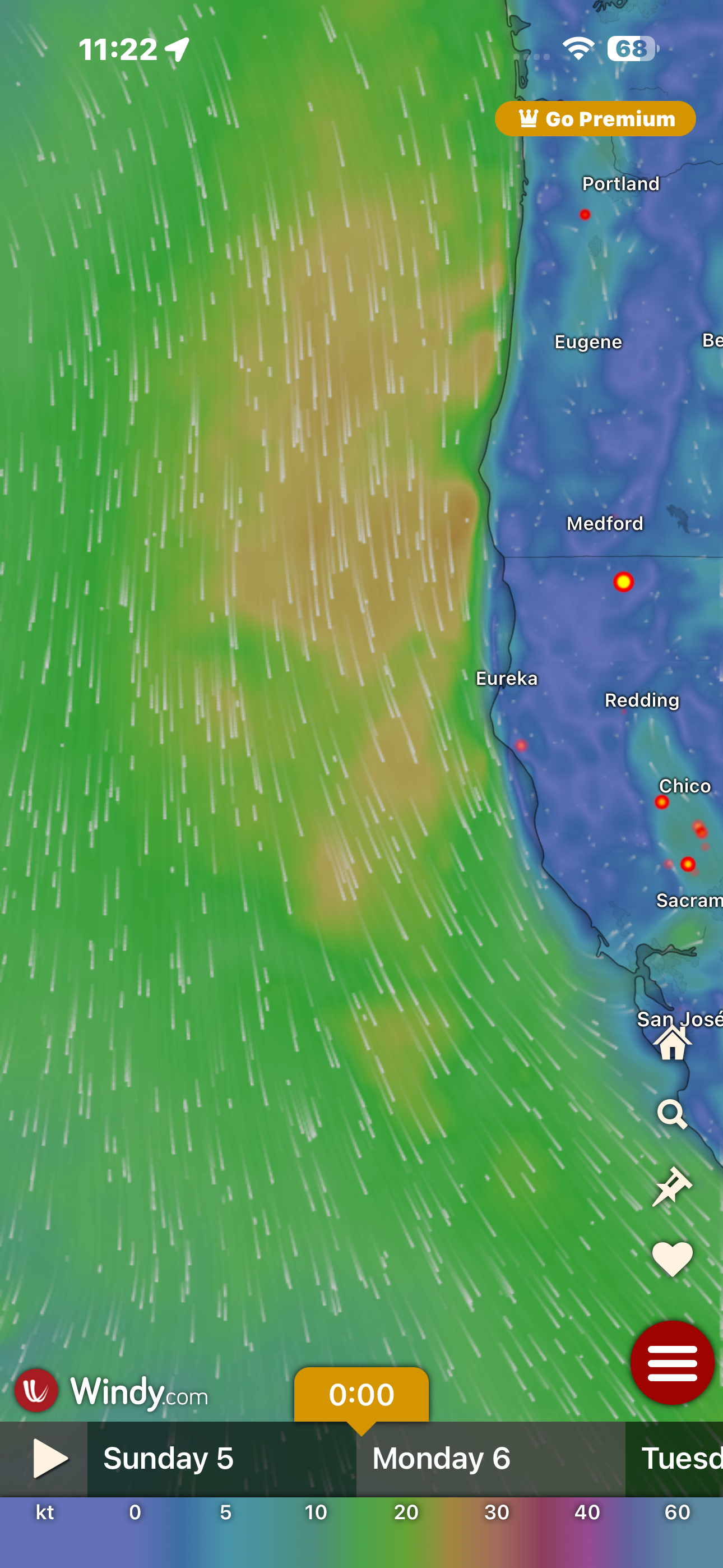
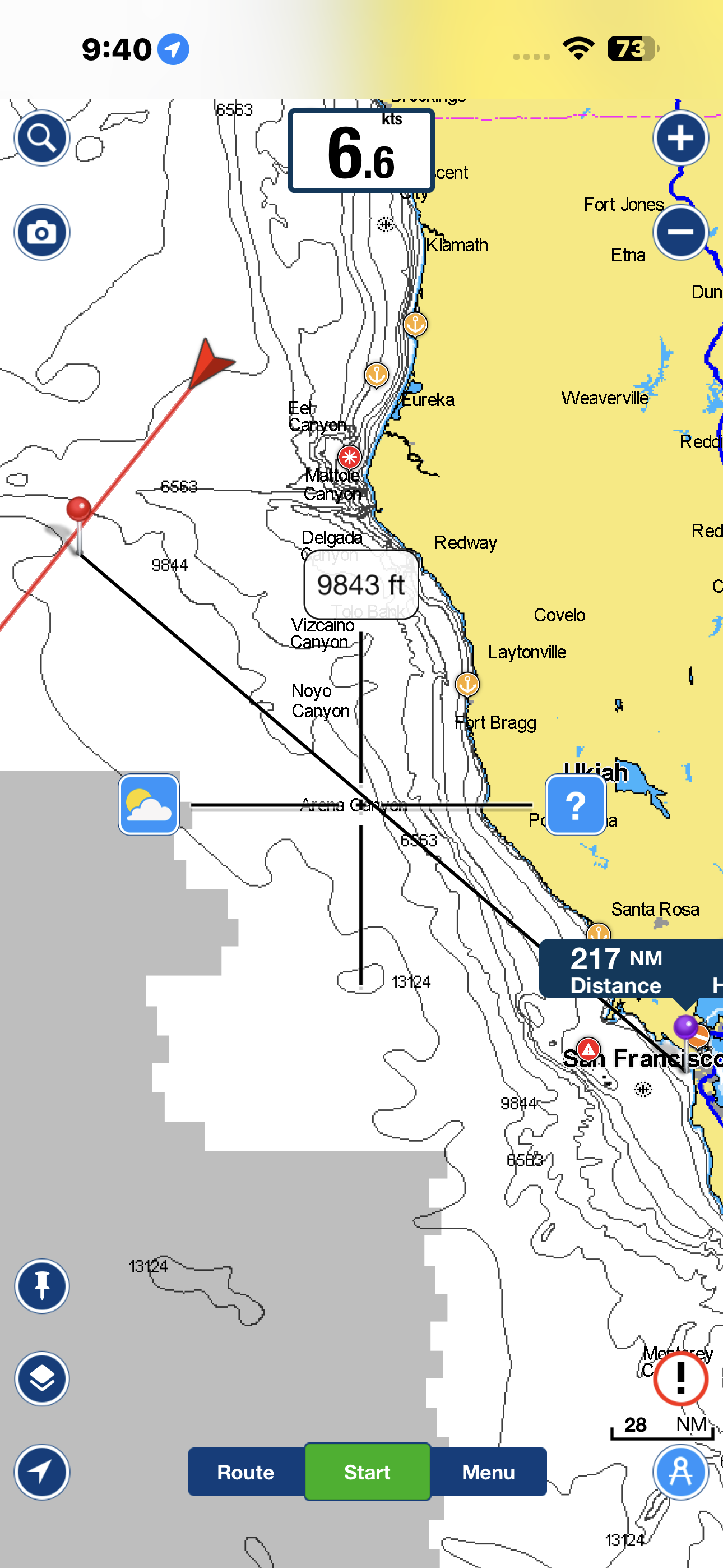
Cape Mendocino is usually the roughest part of the coast and needs to be approached both with caution and confidence. The stretch of water between Eureka and Bodega Bay is over 150 miles. There are options to bail out but they are risky in rough weather so one must be prepared to go without the thought of turning around. The big confused seas often found offshore are really slow to head into and heading into shore to navigate the bar at fort Brag or to tuck into a swell filled little “anchorage” is dangerous. Rounding the cape at a distance is a good idea so a long tack offshore makes it more like a 200 plus mile jump.
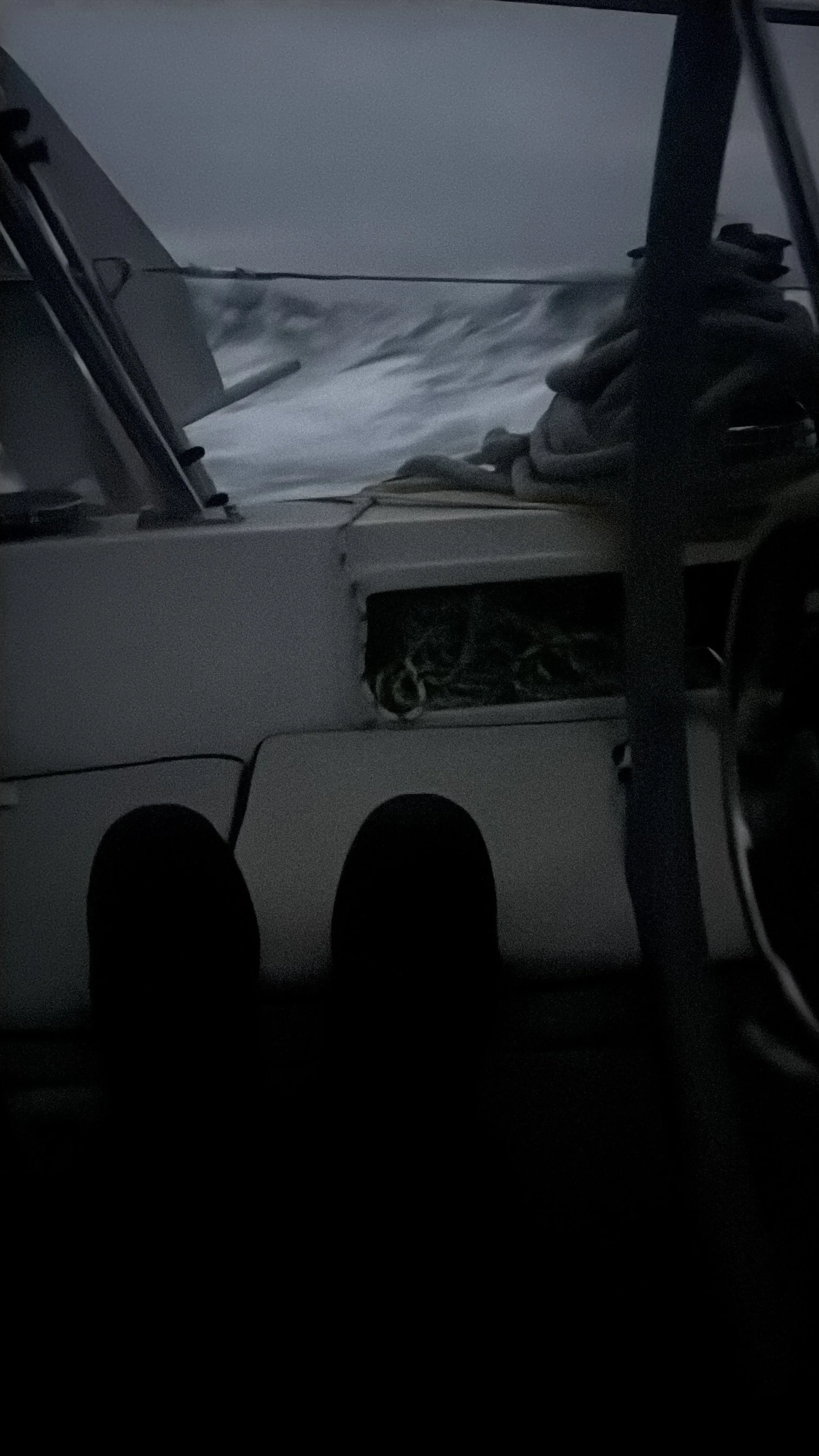
Despite a long motoring section we were looking good on fuel and decided against a stop in Eureka as the wind and seas were supposed to build. We would be seeing 8 to 10 foot seas and up to 30 knots with seas building to the low teens with over 35 knots in the days following. I wanted to get us around quickly.
We approached with a reefed main and headsail and we were “chicken jibing” (tacking instead of jibing) to lighten the load on the hardware when the furled jib got fouled up. Cutter rigged boats are great for long passages because, among other things, they have staysails that act as heavy weather headsails that are ready to go. The disadvantage is that you cant tack the genoa through the foretriangle (the space between the mast and headstay) without furling it at least partialy. It was during this furling and tacking that the lazy jib sheet was allowed to drop below the furler drum and foul up.
I clipped onto the port jack-line and went forward to deal with the fouled jib sheet.
(We do these maneuvers with all hands on deck so it is best done on a watch change so as to not wake the resting watch. This means these longer tacks can set you past your desired lay lines so if the time to change tacks comes in the middle of a three hour watch you sail another hour and a half before jibing. It is a another example of the risk benefit analysis one has to run in their head. I choose to let the crew rest when sailing with inexperienced crew because they often take longer to go to sleep than relaxed and experienced crew and are likely to take longer to get ready for a maneuver on deck.)
When I was on the bowsprit dealing with the jib sheet I noticed the cotter pin holding the clevis pin and associated headstay was about to come out. Typically the clevis pin and the headstay it holds has a lot of load on it however when you have 25 knots abaft the beam the backstay loads up and the headstay loosens up and in conjunction with the oscillating load from our partially furled genoa it looked like the pin might shake out out so I called for some needle nose pliers while my finger held the pin in place and my watch mate clipped on the starboard jack-line to come up and join me forward. Ether the wind or the gofer resulted in a miscommunication and a large pair of large channel locks came up to the foredeck. Needless to say not the ideal tool for the job but I didn’t feel comfortable taking my finger off the pin and walking back to the cockpit and communicating the entire situation to the crew. The time that it took to bend the pin properly resulted in more furling issues and the upper portion of the sail managed to unwrap while the lower portion seized up. This could have been addressed without my prompting after I cleared the jib sheet from the furler drum and set about the issue with the cotter pin but the cockpit wasn’t hearing my commands and wasnt seeing the situation as the partialy furled genoa continued to flog and unfurl..
After three hours from initiating the jibe on the watch change the sail was out and we were on the next board (tack) and significantly past our lay-line and it was my watch again. I had been up since 3 am and was tired. This underscores the importance of getting rest on your off watch. Sometimes we don’t feel tired when we go down for our watch and some people (owners especially) have a hard time getting rest on their off watch but when you loose a watch the sleep deprivation can result in delayed motor skills and cognitive impairment and we need our bodies and minds in good shape with “gas in the tank”. This is one of the many example of giving yourself and crew “leeway”. We must make allowances for the unknown. Even lying in your bunk with your eyes closed helps bring on the parasympathetic nervous system’s recovery process. At one point just after a following watch change making some coffee to contend with the sleepiness I noticed the off watch on their phones in their bunks. Because we sleep feet forward I could see their screens as the lay in the berths in the main saloon. One was starting a game of solitaire and the other was looking at the weather.
At the next watch changed I brought up the importance of sleep again and in this case when one watch has jumped on a grenade and missed their entire off watch and rest there is an understanding that the down watch is using the rest that the other watch gave up. We could have just as well restarted the watches once the “fires were out” but we would have been off that rotation our bodies clock’s were on and it would have been hard to get into a different sleep pattern.
We also discussed meal prep on watch changes. The watch about to go down cooks with one on deck. This cooking is done in gear ready to come up and help their watch mate. This is especially important with green crew who often need 30 minutes at least to get their gear on before coming on deck. More experienced crew can come on deck much faster and still be fully prepared. After the meal the on watch taking over can do the clean up.
It took the crew a week to remember to clip on before getting into the cockpit and to figure out the how to coordinate their tethers and the two jack-lines in the cockpit.